Challenges to Coinmaking
Like any craft, there are unique challenges to coin making, but overcoming these can be part of the fun and joy of creation!
Machinery
We work with antique presses, some dating as far back as the 1880's, which is both a blessing (they're workhorses and will go potentially forever if well taken care of) and a curse (no replacement parts exist, the parent company might not exist anymore, fixing it is a 'you' problem). When we get a "new" (to us) press in, often they come to us broken. It takes the whole shop team to take apart these huge and heavy machines, clean everything, and either repair or replace the parts that are broken. How do you do that when potentially no replacement parts are available? You get creative! Woody is the king of DIY when it comes to mechanical repairs and workarounds. Sometimes a press will fail catastrophically and you have to machine your own parts or get them custom made and it takes a full year to repair (which has happened to us before, we do not recommend.) We've made modifications to machines to make them safer for the operator and more usable, but there is no manufacturer support team that can come bail us out if a machine decides to stop working. One upside though - no patch updates or software service required on a century-old coin press!

Custom rig we built for the Waterbury Knuckle Press to hold the dies and eject the coin out after striking into the chute.
Design
The design of a coin itself must be harmonious and in balance on both sides. Aside from being useful zen philosophy, mechanically metal will kick out a 'fin', where a thin, raised bit of a metal extends vertically out from the coin. It can occur when striking pressure causes the coin's metal to squeeze into the narrow gap between the die neck and the collar (the ring that holds the coin blank in place). If the die is tilted causing a localized area of increased pressure or the striking force is too high. The metal when being struck ~flows~ and big voids on one side can make the metal flow strangely or not fill the space correctly. It's an art and a science! The design dramatically changes with the finishing process - text, dark areas, and light areas are not always intuitive to the artist and may look great on paper or mint but look different once patinaed. Woody often will have to invert portions of the design so it looks correct later since the lowest depths will keep the dark color of the patina and the highest points of the design will be the tumbled bright. He's constantly thinking of how the final product will come out when he's engraving and making changes as needed, and it's a skill that's been refined over many years of practice.

This is a small fin on a custom thnickel coin, they can get much more drastic and sharp.
Production
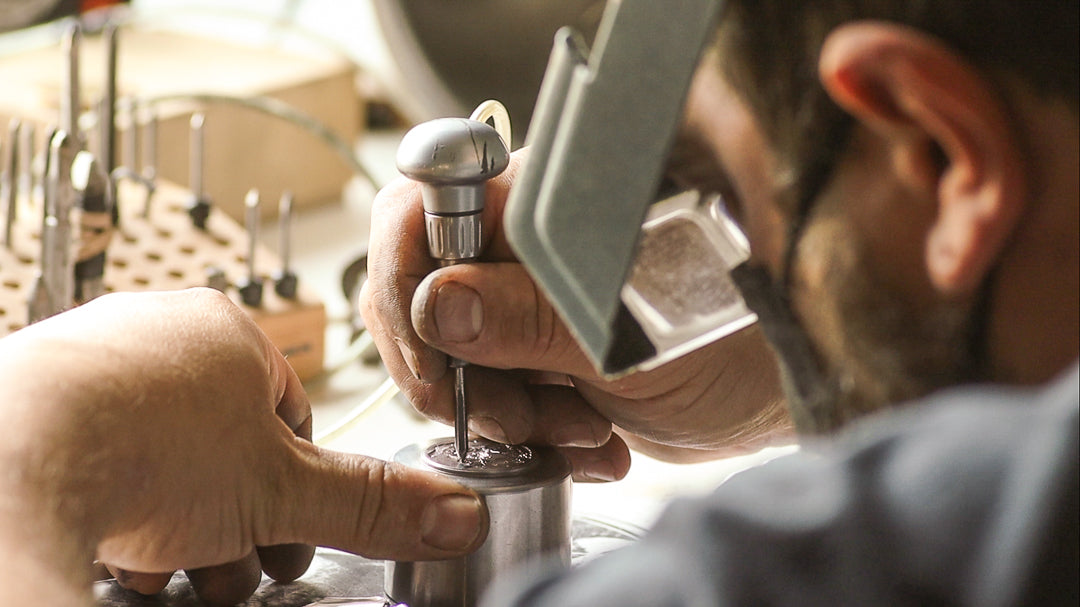
Engraving dies has a very small margin of error, and your mistakes are literally written in steel. It requires learning how to visualize in 3-D depth backwards, since the end result coin design is actually in the negative space of the engraving. If your hand slips and you gauge out a chunk of the surface - it's time to grind it all off and start over! Text is reversed when engraving - a mistake every engraver makes once and then never again (hopefully!) so the die design will often look strange to the eye. Our advice is to get very comfortable with your engraving tools and get some indium (a super soft metal) to do test strikes to see how a coin would come out before hardening the die.

Indium test strike of the Naughty Nice Decision maker design
Size is another constraint of coin making. The larger the coin the easier it is to engrave with so much more surface area for more intricate designs and the more unwieldy it is in the pocket or hand, but on the other end of the spectrum we make especially tiny coins only 1 cm across that are extremely challenging to engrave in great detail. Most medieval coins generally were in the 0.5 to 1.5 inch diameter range, so since we strive for realism and a more authentic experience handling the coins that's where we generally sit as well for the majority of our coins. Oversized coins are terribly impractical to actually carry and use, if you can imagine putting a saucer sized coin in a pouch or pocket. On rare occasion we will make a custom ~2 inch medallion but that's fairly few and far between. It takes exponentially more force to strike a design the larger it is, so the manufacturing process and press we choose will change based on the diameter.

Size comparison: Quarter, Coin of the first Men, Silver Supermoon
Material is something that a lot of people tend to overlook, especially in a world existing under capitalism and a race to the bottom for lowest-possible pricing. The most common and cheapest route to take in making custom coins will almost always be plated. This type of coin is often spun cast in a centrifuge with a two-part mold, so the fidelity of the design has the potential to be extremely diminished compared with the exactness of a struck design. The surface layer is often made thin to be as inexpensive as possible, and can wear off easily with use. While it may look fine in a capsule on a shelf, they don't stand up to constant wear or the environment the same way a solid metal coin does. If the core is made of zinc, zinc is prone to zinc rot and it is destructive to the coin in the same way rust is. Fun fact - this is the reason for why you shouldn't wedge in a bunch of pennies into cracks in walls or stonemasonry - the coins will eventually rot and expand, exerting pressure and potentially breaking the masonry apart. We work bullion grade materials whenever we can - .999 (99.9% pure) fine silver, copper, titanium, niobium, etc., which is more expensive and subject to the whims of rare metal market fluctuations. Each metal acts differently - tumbling time, the way the metal moves, the hardness, if it needs to be annealed or not, how does the darkening agent take to it, how it wears - and these are all things to consider in production workflows and later use.
The "Fantasy" in Fantasy Coins
Sometimes fantasy authors make fantastical currencies in their worlds which is magical but unfortunately we're a terrestrial, unmagical, and mortal workshop still bound by the earthly rules of chemistry and physics here in the shop, and some materials just don't make for good coins (too soft, doesn't strike well, etc.) We try our best but sometimes we just can't figure out a process that is both true to the description while also being visually legible and physically stable. We get as close as we possibly can get to what is described while remaining within the confines of our material reality. (At least for now. When someone figures out how to apply magic to manufacturing, please let us know!)
Research
The processes we use today are born of decades of refinement and experimentation, writing what you're doing down, changing things to be more efficient, dialing in details. There's a fair amount of chemistry, mathematics, and physics going on in the background of all the artistry and craftsmanship. Some information was not written down and just passed down from engravers and minters in localized communities, some was pieced out in rare hard to find books, other things are literally just trial and error. We are constantly iterating and trying to perfect processes still (almost 25 years into this!) and sometimes you learn the most by making mistakes.
Business
Licensing
One of the most popular comments we hear is "I want coins from _____ (series, game, show) can you make them for me?" and unfortunately, we generally can't unless we have a licensing agreement in place, which takes a fair amount of resources and work to make happen, and we are but a small team. We're very proud of the fact that our fantasy coins are officially licensed so that they're as canon accurate to what would be in world as possible, but that also means we can't just make and sell whatever we want. We're in this for the long haul and have to comply with copyright laws. However, we do love to hear what would be a great fit and if there's an audience there that would be interested in the things we make, which helps inform which licenses we should be looking into. It also doesn't hurt to let the creators merchandising team know you'd like to see coins from us - word of mouth can be really powerful! Sometimes our collaborations are full licensing deals and other times they might be in the form of a custom product for an official event or crowd-funding campaign or limited edition merchandise drop.
Tl;dr: we would love to make your favorite thing, but we have to obey copyright laws too. If you want something made from your favorite IP, let them know you want to us make it!
Counterfeits
Counterfeits, alas. This is a tough one and always feels like a losing battle in which there are always vastly more counterfeiters than there are the resources to combat it. As any artist on the internet knows - it's so disheartening when you spend so many hours designing and making something cool and unique, and someone scrapes it and passes off a duplicate as their own. If someone gets scammed, if they're lucky they may receive -something- back or just be out money, worst case scenario their personal identifying or financial information may be compromised. We hate when this happens and we try our best to help when we can, but the best way to combat this is just to be aware and vigilant of the ads you see, and always double-check that you're purchasing from the legitimate site. We try our best to report and get fraudulent pages taken down but more will always pop back up.
Weirdly, a number of people reach out to try to convince us to make counterfeit currency coins. This happens more than you'd think and people think they're being ever so sly. Our advice is - just don't. We will never do it and for any aspiring coin makers out there it's definitely not worth going to jail for!
Mintmaster Advice
Woody says: Stay sharp, have a good way to sharpen your tools frequently and nearby. The best way to do it is have a diamond lap to sharpen with. And be able to see really well! Some people use a microscope, but it can be really hard to use a microscope to engrave. Woody uses a 10x visor. Practice and if you think you need something different grind your own tools to the right shape for what you think you need. If adding a mark or a jig or special pedal or rack would make the process faster, better, or easier on your body, do it! Always be open to learning new things and changing things up if something is not working for you.
Tom says: early on in his coin making journey, the best piece of advice he ever got was to get a good lathe and become very good friends with it. Research and learn as much as you can from Youtube videos and books before you ever start looking at buying a press. Keep in mind it's going to be hot and sweaty machining work, and mistakes are literally etched in steel and time consuming to fix. You will need a variety of skills - mechanical, metallurgical, and artistic. Practice makes perfect. Copper is a great material to get started with. The press is often going to be the biggest roadblock to coin making. We have found we need at minimum 50 tons of force to make an average sized coin, and you don't want to ever max out a press for speed or power - stay within the manufacturer's stated safety limits. Finding the right press for you will depend on your location, needs, budget, and luck. I promise it's not as easy as we make it look!
If you want to watch some deeper-dive videos about the coin making process, check out our Youtube channel!
We hope this helps shed some light on the unique challenges in coin making.
Let us know what else you'd like to see!